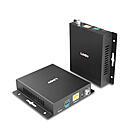
The Lindy Cat.6A USB Type C HDBaseT 3.0 Extender is a high-performance, reliable solution for extending AV and data signals over long distances via Cat.6A network cable.
The following distance and resolution combinations are possible when using high-quality Cat.6A or higher U/UTP or F/UTP cable:
70m: 3840x2160@60Hz 4:4:4 8bit / 4:2:2 12bit
100m: 3840x2160@30Hz 4:4:4 8bit / 4:2:2 12bit
Supporting uncompressed resolutions up to 4K Ultra HD, video can be viewed in stunning clarity, while HDR (High Dynamic Range) ensures enhanced brightness, greater contrast, and a much wider colour gamut.
This extender provides fully featured USB Type C input and output ports to connect sources such as a PC or laptop to touchscreens supporting DisplayPort Alternate Mode and USB 2.0 data transfer. The USB Type C charging port on the transmitter delivers up to 100W power to the Type C input when connected to an external power supply.
PoC (Power over Cable) functionality with On/Off switch provides additional flexibility. This allows power to be supplied alongside data through Cat.6A network cable in a point-to-point connection between the transmitter and receiver, meaning only a single power supply is required at one side of the installation.
Users have complete control of the unit via APIs over RS-232 or the USB Type C service port, with EDID presets, copy, user-defined functions, and a pattern generator.
Additional USB 2.0 device ports are available on both the transmitter and receiver, enabling applications such as KVM, collaboration, and meeting room solutions.
The extender also supports any USB Type C DP Alt Mode to Video converter, allowing connections to HDMI® or DisplayPort screens via the receiver's output.
HDBaseT is a globally recognised standard for high-quality distribution of AV content and other technologies, including power and control, over long distances via low-cost Cat.6 or higher cable.
HDBaseT Trademark and the HDBaseT Alliance logo are trademarks of the HDBaseT Alliance.
Please note: the quoted lengths and resolutions are achievable only with a direct connection between the transmitter and receiver using good quality Cat.6A or higher cable. Using other cable types, couplers, or patch panels may reduce achievable distances.