You are here: » Homepage
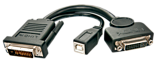
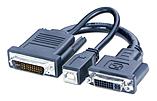
The USB connection is used for control of the computer via the projector remote control, if the projector supports this feature.
For using the remote control of the projector in the presentations page, forward / backward command is transmitted to the computer.
Furthermore, via the USB port, Firmware Updates can be carried out - e.g. for an Infocus Projector.
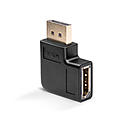
The Lindy DisplayPort 1.4 right angled adapter is a compact solution for connecting DisplayPort cables to DisplayPort monitors with recessed ports, or within limited space where cable connector sizing may affect installation. This adapter allows for a 90° connection from the right of the display.
With DisplayPort 1.4 support, this adapter can be used with DisplayPort 1.4 cables and monitors, while also being backwards compatible with previous DisplayPort specifications. 8K@60Hz resolutions can be easily passed through the adapter, ensuring this adapter is an ideal tool within wall mounted digital signage installations, gaming setups or educational spaces, with no lasting impact on a connected cables strain relief or lifespan.
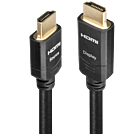
Please note: These cables can be only used in one direction, from source to display.*
* LINDY active cables must be connected in accordance with the instructions. The connector marked with "Monitor" must be connected to the monitor or screen. Failure to connect the cable in the correct manner will result in no signal.
Some projectors have recessed HDMI sockets. You should make sure they can accommodate the connector used on this cable. The connector dimensions are 19 x 38 x 11mm (WxDxH).
High Speed HDMI Active Cables can not be connected together or 'daisy chained'.
The HDMI High Speed specification offers many benefits over the previous version:
HDMI Ethernet Channel (HEC)
The High Speed HDMI HEC Cable specification has an additional data channel that enables high speed bidirectional communication. Connected devices that include this feature will be able to send and receive data via 100mb/sec Ethernet, making them instantly ready for any IP based application.
It will also allow internet enabled HDMI devices to share their internet connection with other HDMI devices without the need for a separate Ethernet cable. This new feature will also provide the connection platform to allow HDMI enabled devices to share content between devices.
Audio Return Channel (ARC)
The HDMI specification has an Audio Return Channel that will reduce the number of cables required to deliver audio upstream for processing and playback. In cases where HDTV's are directly receiving audio and video content, the Audio Return Channel allows the HDTV to send the audio stream to the A/V receiver over the HDMI cable, eliminating the need for an extra cable.
3D
The HDMI specification defines common 3D formats and resolutions for HDMI-enabled devices. The specification will standardise the input/output portion of the home 3D system and will specify up to dual-stream 1080p resolution.
4K
The HDMI specification will enable HDMI devices to support high-definition (HD) resolutions four times beyond the resolution of 1080p. Support for 4K will allow the HDMI interface to transmit content at the same resolution as many digital theatres.
Formats supported include:
• 3840 x 2160 @ 24Hz/25Hz/30Hz/60Hz
• 4096 x 2160 @ 24Hz
Content Type
Content Type enables, automated picture setting selection with no user intervention. The Content Type feature enables a display to auto-detect the correct viewing mode to match the Content Type it is receiving from a source device, and to switch modes when a new connected source is selected. Content Type supports content profiles for gaming, movie, photograph and text viewing modes.
Audio Formats
HDMI supports multi-channel digital audio on a single cable. It transmits all ATSC HDTV standards and supports 8-channel, 192kHz, uncompressed digital audio and all currently available compressed formats (such as Dolby Digital & DTS), HDMI 1.3 adds additional support for new lossless digital audio formats Dolby TrueHD and DTS-HD Master AudioTM with bandwidth to spare to accommodate future enhancements and requirements.
Amongst other the following formats are supported:
• SA-CD
• DTS-HD Master AudioTM
• DVD-Audio
• Dolby TrueHD
• Dolby Digital / Plus
• MPEG1 Layer I / II
• MPEG2
• MP3
• AAC LC
• DST / DSD (as used in SA-CD)
• DTS
• ATRAC
• WMA Pro
• MLP (as used in DVD-Audio)
Expanded Support for Colour Spaces
HDMI technology supports colour spaces designed specifically for digital still cameras. By supporting sYCC601, Adobe RGB and AdobeYCC601, HDMI-enabled display devices will be capable of reproducing more accurate life-like colours when connected to a digital still camera.
Package Contents:
10m Active 4K HDMI Cable with Ethernet
LINDY Manual
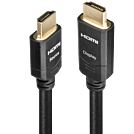
Please note: These cables can be only used in one direction, from source to display.*
* LINDY active cables must be connected in accordance with the instructions. The connector marked with "Monitor" must be connected to the monitor or screen. Failure to connect the cable in the correct manner will result in no signal.
Some projectors have recessed HDMI sockets. You should make sure they can accommodate the connector used on this cable. The connector dimensions are 19 x 38 x 11mm (WxDxH).
High Speed HDMI Active Cables can not be connected together or 'daisy chained'.
The HDMI High Speed specification offers many benefits over the previous version:
HDMI Ethernet Channel (HEC)
The High Speed HDMI HEC Cable specification has an additional data channel that enables high speed bidirectional communication. Connected devices that include this feature will be able to send and receive data via 100mb/sec Ethernet, making them instantly ready for any IP based application.
It will also allow internet enabled HDMI devices to share their internet connection with other HDMI devices without the need for a separate Ethernet cable. This new feature will also provide the connection platform to allow HDMI enabled devices to share content between devices.
Audio Return Channel (ARC)
The HDMI specification has an Audio Return Channel that will reduce the number of cables required to deliver audio upstream for processing and playback. In cases where HDTV's are directly receiving audio and video content, the Audio Return Channel allows the HDTV to send the audio stream to the A/V receiver over the HDMI cable, eliminating the need for an extra cable.
3D
The HDMI specification defines common 3D formats and resolutions for HDMI-enabled devices. The specification will standardise the input/output portion of the home 3D system and will specify up to dual-stream 1080p resolution.
4K
The HDMI specification will enable HDMI devices to support high-definition (HD) resolutions four times beyond the resolution of 1080p. Support for 4K will allow the HDMI interface to transmit content at the same resolution as many digital theatres.
Formats supported include:
• 3840 x 2160 @ 24Hz/25Hz/30Hz/60Hz
• 4096 x 2160 @ 24Hz
Content Type
Content Type enables, automated picture setting selection with no user intervention. The Content Type feature enables a display to auto-detect the correct viewing mode to match the Content Type it is receiving from a source device, and to switch modes when a new connected source is selected. Content Type supports content profiles for gaming, movie, photograph and text viewing modes.
Audio Formats
HDMI supports multi-channel digital audio on a single cable. It transmits all ATSC HDTV standards and supports 8-channel, 192kHz, uncompressed digital audio and all currently available compressed formats (such as Dolby Digital & DTS), HDMI 1.3 adds additional support for new lossless digital audio formats Dolby TrueHD and DTS-HD Master AudioTM with bandwidth to spare to accommodate future enhancements and requirements.
Amongst other the following formats are supported:
• SA-CD
• DTS-HD Master AudioTM
• DVD-Audio
• Dolby TrueHD
• Dolby Digital / Plus
• MPEG1 Layer I / II
• MPEG2
• MP3
• AAC LC
• DST / DSD (as used in SA-CD)
• DTS
• ATRAC
• WMA Pro
• MLP (as used in DVD-Audio)
Expanded Support for Colour Spaces
HDMI technology supports colour spaces designed specifically for digital still cameras. By supporting sYCC601, Adobe RGB and AdobeYCC601, HDMI-enabled display devices will be capable of reproducing more accurate life-like colours when connected to a digital still camera.
Package Contents:
15m Active 4K HDMI Cable with Ethernet
LINDY Manual
 |
 |