
We use third party services that help us to improve and optimize our online experience. For the use of certain services we need your prior consent which can be revoked at any time. You can find further information on data protection in our privacy policy
Details
In order to optimise our website, we use services that collect and aggregate data and make it available to us as a statistical overview.
You are here: » Homepage
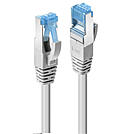
Cat.6A U/UTP LSZH network cable with support for bandwidth up to 500MHz and features a snagless design with gold plated contacts for ethernet standards up to 10GBase-T.
Cat.6A cable for operating frequencies up to 500MHz. The unshielded version (U/UTP) can be used for Gigabit Ethernet thanks to the special design of the electrophysical parameters (NExT, FExT, etc.) despite the lack of shielding. These cables are manufactured and tested according to the ISO/IEC 11801 specification. The cables are packaged individually in a polybag.
The gold-plated contacts ensure reliable, corrosion-free connections over extensive periods of time. A robust snagless strain relief design prevents damage to the connector latch during installation and removal.
Available lengths: 0.3m, 0.5m, 1m, 2m, 3m, 5m, 7.5m, 10m, 15m
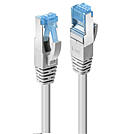
Cat.6A U/UTP LSZH network cable with support for bandwidth up to 500MHz and features a snagless design with gold plated contacts for ethernet standards up to 10GBase-T.
Cat.6A cable for operating frequencies up to 500MHz. The unshielded version (U/UTP) can be used for Gigabit Ethernet thanks to the special design of the electrophysical parameters (NExT, FExT, etc.) Without the need for shielding. These cables are manufactured and tested according to the ISO/IEC 11801 specification.
The gold-plated contacts ensure reliable, corrosion-free connections over extensive periods of time. A robust snagless strain relief design prevents damage to the connector latch during installation and removal.
Available lengths: 1m, 2m, 3m
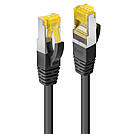
Cat.6A U/UTP LSZH network cable with support for bandwidth up to 500MHz and features a snagless design with gold plated contacts for ethernet standards up to 10GBase-T.
Cat.6A cable for operating frequencies up to 500MHz. The unshielded version (U/UTP) can be used for Gigabit Ethernet thanks to the special design of the electrophysical parameters (NExT, FExT, etc.) Without the need for shielding. These cables are manufactured and tested according to the ISO/IEC 11801 specification.
The gold-plated contacts ensure reliable, corrosion-free connections over extensive periods of time. A robust snagless strain relief design prevents damage to the connector latch during installation and removal.
Available lengths: 1m, 2m, 3m
 |
 |
Cat 6A cables are the current standard for structured network cabling in offices, data centres and industry. They transmit up to 10 Gbit/s (10GBASE-T) at a frequency of 500MHz over a link length of up to 100m. This gives them headroom for 10 Gigabit Ethernet, Wi-Fi access points, Power over Ethernet as well as IP streaming and HDBaseT in AV installations.
Benefits at a glance: 10 Gbit/s over the full link length, future-proofing for growing bandwidth demands and full backward compatibility with Gigabit Ethernet.
Cat 6A patch cables with RJ45 connectors connect PCs, switches or routers to wall outlets or patch panels. Flexible stranded conductors and a strain relief boot on the connector protect against cable breakage.
Cat 6A installation cables with solid copper conductors (solid core) are permanently installed in walls, cable ducts and raised floors and terminated on patch panels and outlets.
The designation describes the overall shield and the individual shielding of the four twisted pairs.
U/UTP is unshielded and suitable for environments with low interference.
U/FTP shields each pair with foil.
S/FTP combines an overall braided shield with foil-shielded pairs (PiMF) and offers the best shielding – recommended for professional installations, industrial environments or proximity to power lines.
Cat 5e achieves 1 Gbit/s at 100MHz. Cat 6 operates at 250MHz and only reaches 10 Gbit/s up to around 55m. Cat 6A delivers 10 Gbit/s at 500MHz over the full length.
The standard specifies a maximum of 100m: 90m of installation cable plus up to 10m of patch cable.
Cat 7 requires special connectors for full performance. With RJ45 connectors it is limited to Cat 6A level, so Cat 6A is usually the sensible choice.
Cat 6A cables from Lindy: Lindy offers Cat 6A network cables in a range of shielding types, colours and lengths up to 90m, many of them in LSZH versions. Custom lengths and volume pricing are available on request. System integrators and IT departments can get project advice from our technical sales team.